Introduction
Professional decompiler for VCL applications written in Delphi or built with C++Builder. Analyze Win32/Win64 code, forms, units and classes for reverse engineering, forensics and code recovery.
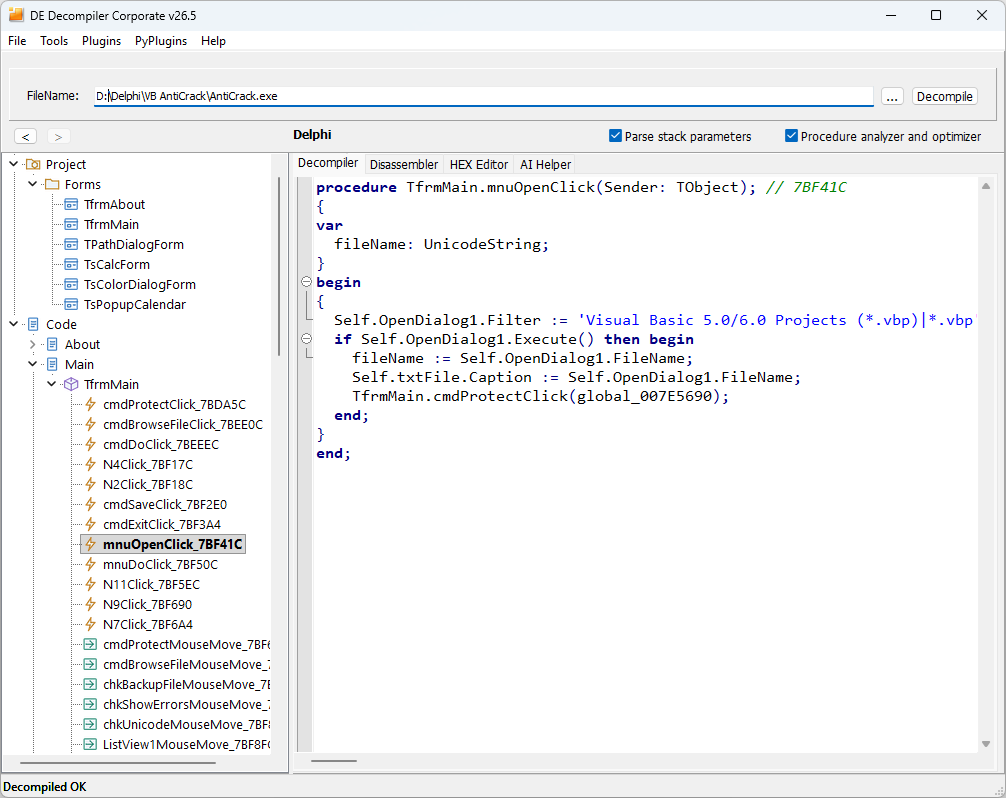
Decompile VCL applications written in Delphi 3–13 or built with C++Builder, for Win32 and Win64, into Delphi-like Pascal. Recover control flow, calls, forms, units and classes from native instructions and available metadata, then follow the implementation from a VCL event to its handler.
Use the recovered structure and code to investigate program behavior, malware and potentially unwanted or concealed functionality. Follow VCL events to their handlers, examine control flow and calls, and use disassembly and the HEX Editor for detailed inspection.
Native-code decompilation
The high-level listing reconstructs program logic, including if conditions, case blocks, loops and calls to recognized VCL methods. Recognized units, classes and public functions provide a structural view; heuristic discovery also looks for private functions within each unit.
Forms and tools
Inspect recovered VCL controls and properties in the read-only designer and navigate from events to their handlers. Export units and forms as a Pascal/DFM project or a combined .pas listing. The integrated obfuscator supports Win32 and Win64 VCL applications written in Delphi or built with C++Builder.
Information retained in the binary
The result is Delphi-like code, rather than the original source text. Native compilation does not preserve all source-level information. Local variable names are commonly generated, data structure layouts may be inferred from access sizes and addresses, and an unidentified call may be displayed without its original VCL method name. Compiler-specific RTTI knowledge helps recover the names and types that remain available.
The high-level listing reconstructs native program logic for analysis with the detail supported by that evidence. Check inferred types, unexpected expressions and important conclusions against the corresponding instructions. See Interpreting recovered code.
Source recovery is an additional use. The output does not reproduce a compilable source project. Before opening recovered code in an IDE, manually analyze and correct decompilation inaccuracies and incompatibilities and restore missing dependencies.
Applications built with C++Builder
DE Decompiler supports VCL applications built with C++Builder for Win32 and Win64. Recover and visualize forms, examine units, classes and functions, follow event handlers and use the other analysis and export tools in the same workspace.
C++Builder-specific library RTTI knowledge bases are not yet available. Functions outside the shared VCL coverage, and object properties or methods that cannot be identified, may be shown without their library names. Code decompilation quality for C++Builder is therefore noticeably lower than for applications written in Delphi. This limitation concerns code-reconstruction quality and library-name recognition. The other supported features remain available for C++Builder under the same edition rules as for applications written in Delphi.
C++Builder code is reconstructed as Delphi-like Pascal, with PAS/DFM output. It is not converted back into the original C++ source. As with other native-code reconstruction, review and correct inferred types, generated names and decompilation inaccuracies manually before using the recovered material in an IDE.
Editions
High-level code decompilation, AI Helper, the HEX Editor and obfuscation require a Single Developer or Enterprise license. Free Lite recovers VCL form information and provides native disassembly and String references. See Licensing.