
Units, classes and functions
Recovered declarations provide a starting point for examining the structure of supported VCL applications written in Delphi or built with C++Builder.
Unit declarations
Select a unit under Code to view its reconstructed declaration listing. Use the unit name, available references, declared classes and visible members to establish which part of the application you are examining.
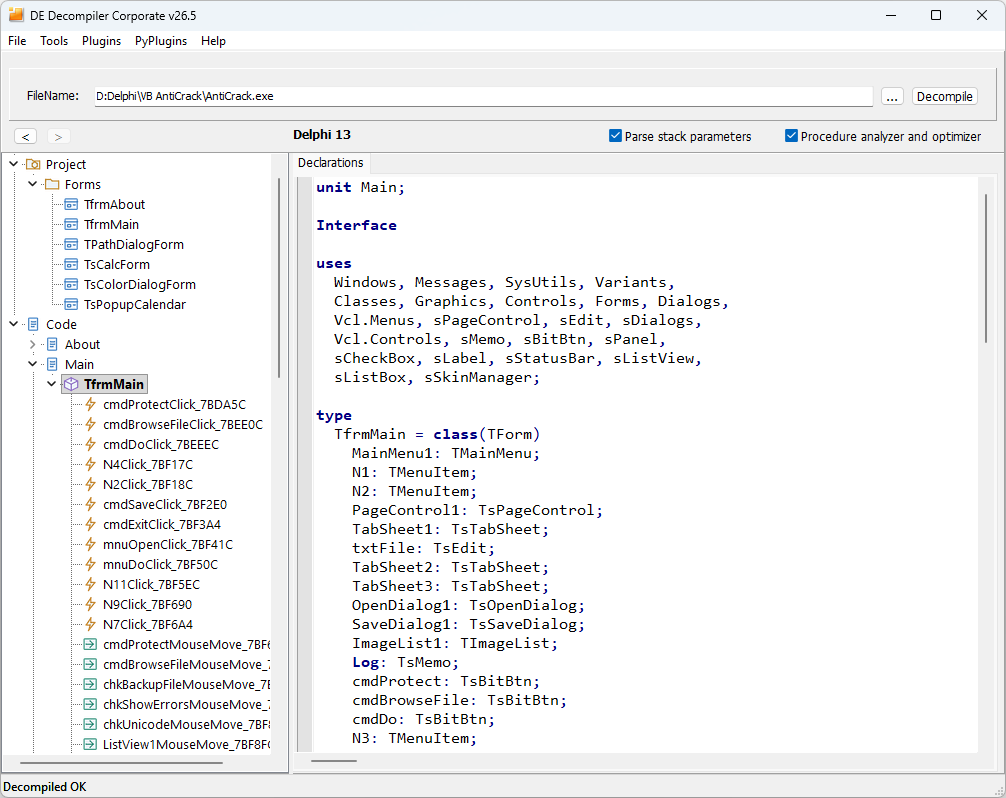
An excerpt from the recovered class declaration:
type
  TfrmMain = class(TForm)
    MainMenu1: TMainMenu;
    N1: TMenuItem;
    N2: TMenuItem;
    PageControl1: TsPageControl;
Classes and methods
Expand a recognized class and select a method or function. Read the signature and body together: a plausible body does not by itself confirm an inferred parameter type or class-field interpretation.
Public and private functions
Recognized public functions and methods appear in the recovered structure. The decompiler also attempts to locate private functions in each unit. Private discovery is heuristic; investigate unexpected boundaries, missing arguments, or inconsistent unit associations using disassembly.
Compiler-generated anonymous-method frames are hidden from the normal tree. Search results, address jumps and history can reveal a required frame. Show VCL classes provides the complete class view. Opening a unit or class declaration does not require decoding all its methods.
Names and analyst annotations
Distinguish names preserved in the binary from generated identifiers and names assigned during analysis. A reconstructed or analyst-assigned name may help explain a procedure, but it does not prove that this was the original source identifier.